What Should I Teach My Child? 8 Age-by-Age Learning Guides (0–5+ Years)
by Digyfindy
Tags:
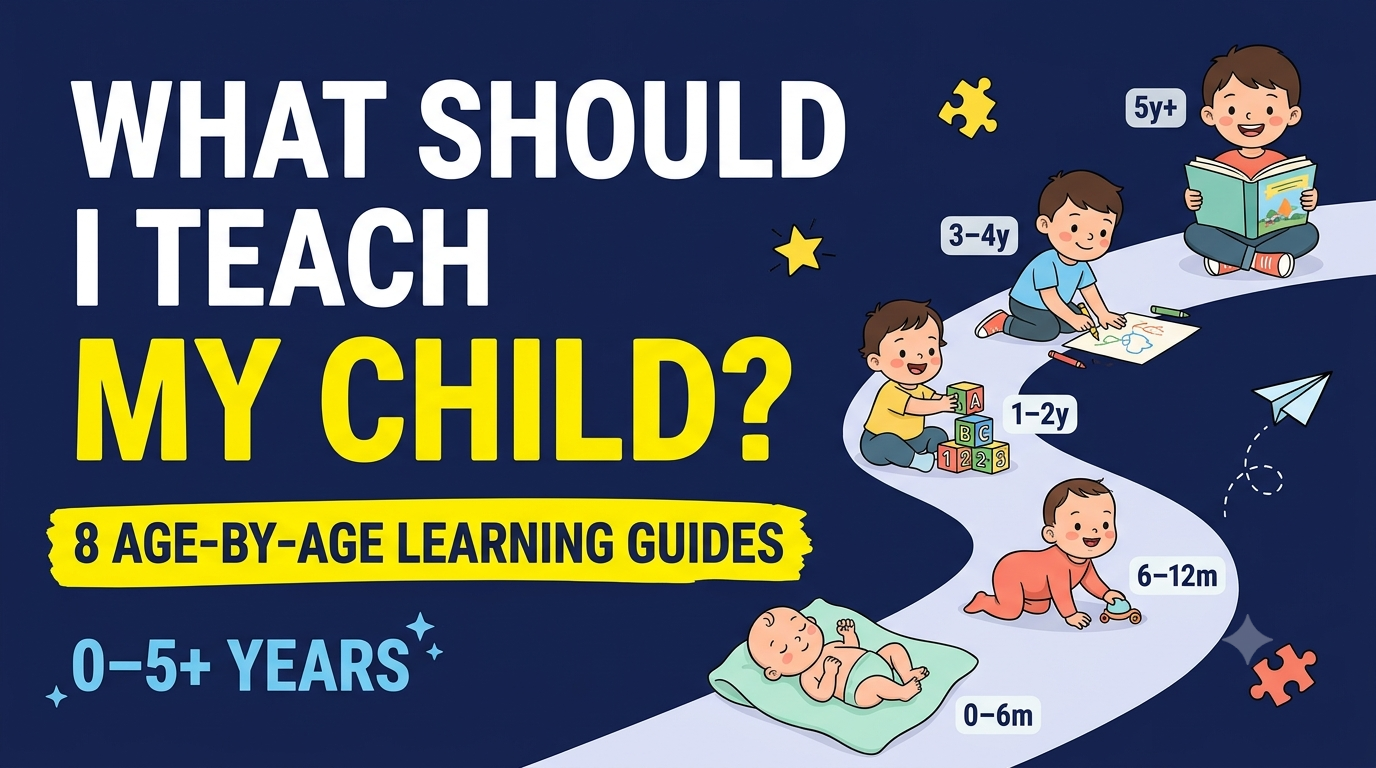
What Should I Teach My Child? 8 Age-by-Age Learning Guides (0–5+ Years)
Have you ever looked at your little one and wondered, "Am I teaching them enough?"
Maybe your baby is only a few months old, or perhaps your toddler has started asking questions about everything around them. Either way, it's natural to wonder what should I teach my child at each stage of growing up.
The good news? You don't need expensive toys, complicated lessons, or hours of teaching every day.
Children learn through everyday experiences. Talking during mealtime, singing a silly song, looking at picture books, counting their toys, or simply exploring the garden can become wonderful learning opportunities.
If you're wondering what should I teach my child from infancy to the preschool years, this age-by-age guide will give you simple ideas to try at home.
We'll look at what children can begin exploring from 0–6 months all the way to 5+ years, including language, early maths, creativity, movement, and everyday life skills.
Remember, these are general age ranges, not strict milestones. Every child develops differently, and learning should feel like fun—not a competition.
Table of Contents
1. What Should I Teach My Child From 0–6 Months?
<text> <escape></escape> </text>
<text> <escape> </escape> </text>
The first six months are all about connection, exploring the senses, and getting familiar with the world.
At this age, your baby doesn't need formal lessons. Your voice, face, touch, and everyday interactions are already teaching them so much.
Here are a few simple activities to try:
Talk to Your Baby Often
Tell your baby what you're doing, even if they can't understand your words yet.
For example:
-
"Let's change your diaper."
-
"Here's your milk."
-
"Look at that pretty tree!"
Your baby gets to hear different sounds, rhythms, and expressions.
Sing Songs
You don't need to be a great singer. Your baby isn't judging your musical skills!
Sing simple nursery rhymes, lullabies, or your favourite songs. Repeating familiar songs helps babies become familiar with sounds and language.
Try Tummy Time
When your baby is awake and supervised, offer short periods of tummy time.
It helps babies practise lifting their heads and developing the muscles needed for movement.
Always place your baby on their back for sleep.
Show Black-and-White Cards
Young babies may enjoy looking at simple, high-contrast patterns.
Show black-and-white cards or picture books while your baby is awake and comfortable. Hold them at a suitable viewing distance and let your baby look around.
The goal at this age: Bonding, listening, visual exploration, and early physical development.
2. What to Teach a Baby From 6–12 Months
This stage can be surprisingly entertaining!
Your baby may become more curious about sounds, faces, toys, and everything happening around them. You might even notice them trying to copy your expressions or sounds.
Here are some easy learning ideas.
Introduce Picture Books
Choose colourful board books with large pictures.
Point to familiar objects and say their names.
For example:
-
"Look, that's a dog!"
-
"Here is a ball."
-
"Can you see the little bird?"
Let your baby touch and explore the book with supervision.
Teach Animal Sounds
Babies often enjoy hearing funny animal sounds.
Try making sounds such as:
-
Dog – Woof woof!
-
Cat – Meow!
-
Cow – Moo!
-
Duck – Quack!
Repeat the sounds and give your baby time to respond.
Sing Nursery Rhymes
Choose simple songs with repeated words and actions.
You can clap, gently move your hands, or use facial expressions to make the experience more interesting.
Name Familiar Objects
Use everyday moments to introduce new words.
Name things your baby sees regularly:
-
Cup
-
Spoon
-
Ball
-
Chair
-
Bottle
-
Shoes
There's no need to turn it into a test. Just repeat the words naturally during your day.
The goal at this age: Sound recognition, early communication, curiosity, and familiar object recognition.
3. Learning Activities for 12–18 Months
Welcome to the stage where little explorers want to touch, grab, point, and investigate everything!
Your toddler may start using a few words, understanding familiar instructions, and showing interest in everyday objects.
This is a wonderful time to introduce simple concepts.
Teach Body Parts
Start with familiar body parts.
During play or bath time, gently point to:
-
Nose
-
Eyes
-
Ears
-
Mouth
-
Hands
-
Feet
Ask simple questions such as, "Where is your nose?"
You can also point to your own nose and let your toddler copy you.
Introduce Everyday Objects
Show your child common household objects and explain what they are used for.
For example:
-
A spoon is for eating.
-
A cup is for drinking.
-
A brush is for hair.
-
Shoes go on our feet.
Keep the explanations short and easy to understand.
Encourage First Words
Talk about things your toddler is interested in.
If they point to a ball, say, "Yes! That's a ball."
If they say a word incorrectly, repeat it naturally rather than making them feel wrong.
Give Simple Instructions
Try easy one-step instructions such as:
-
"Bring your shoes."
-
"Give me the ball."
-
"Wave bye-bye."
-
"Put the toy here."
Use gestures to help your child understand.
The goal at this age: Early vocabulary, understanding simple language, and learning about everyday life.
4. What to Teach a Toddler From 18–24 Months
Your toddler is becoming more independent, and their curiosity may seem endless.
They might want to do everything themselves. Eating with a spoon, choosing toys, opening boxes—every little activity becomes an adventure.
Here are some learning activities to introduce.
Introduce Basic Colors
Start with a few common colors:
-
Red
-
Blue
-
Yellow
-
Green
Use toys, clothes, fruits, and household objects to make learning natural.
For example, while playing with blocks, say, "Can you find the red block?"
Name Fruits and Vegetables
Mealtime is a great opportunity to introduce food names.
Show your toddler familiar foods such as:
-
Apple
-
Banana
-
Orange
-
Carrot
-
Potato
-
Tomato
You can also talk about their colors, shapes, and textures.
Always offer foods in age-appropriate, safely prepared pieces to reduce choking risks.
Try Matching Activities
Matching games are a fun way to encourage observation.
You can try:
-
Matching two identical pictures.
-
Pairing socks.
-
Matching toy animals.
-
Finding two objects of the same color.
Start with only a few items so the activity doesn't become overwhelming.
Encourage Scribbling
Give your toddler large crayons and plenty of paper.
Let them make lines, circles, and random marks.
Don't worry about creating beautiful drawings. At this stage, it's about exploring movement and enjoying creativity.
Use age-appropriate, non-toxic art materials and supervise closely.
The goal at this age: Early color recognition, observation, hand control, and creative exploration.
5. Things to Teach a 2–3-Year-Old
This is when learning can become a little more interactive.
Your child may enjoy naming things, singing songs, sorting toys, and trying simple activities independently.
You can start introducing early academic concepts through play.
Teach Basic Shapes
Begin with simple shapes:
-
Circle
-
Square
-
Triangle
-
Rectangle
Look for shapes around your home.
A clock might look like a circle, a book might look like a rectangle, and a window might look like a square.
This helps your child connect what they learn with the real world.
Start Counting
Begin with numbers from 1 to 5, then gradually introduce more.
Count everyday objects together:
-
One, two, three blocks.
-
One, two, three bananas.
-
One, two, three toy cars.
Make counting part of play rather than asking your child to memorise numbers.
Introduce Alphabet Recognition
Start showing a few letters, especially the letters in your child's name.
Use alphabet books, magnetic letters, or colourful letter cards.
At this stage, recognising and becoming familiar with letters is more important than memorising the entire alphabet.
Try Simple Puzzles
Choose puzzles with large, easy-to-handle pieces.
Animal puzzles, shape puzzles, and familiar object puzzles can encourage problem-solving and hand-eye coordination.
The goal at this age: Early number awareness, shape recognition, curiosity, and simple problem-solving.
6. Learning Activities for 3–4-Year-Olds
At this age, children often enjoy stories, pretend play, drawing, and activities that let them use their imagination.
You can gradually introduce skills that prepare them for preschool and kindergarten.
Introduce Phonics Sounds
Help your child become familiar with the sounds letters make.
For example:
-
A says /a/ as in apple.
-
B says /b/ as in ball.
-
C says /k/ as in cat.
Use picture cards, songs, and simple word games.
Keep the activities short and enjoyable.
Practise Scissor Skills
Introduce child-safe scissors designed for young children.
Let your child practise cutting paper strips under close adult supervision.
Start with simple straight lines before trying other shapes.
Never leave scissors within a young child's reach.
Encourage Storytelling
Read short picture books together.
After reading, ask questions such as:
-
"Who was in the story?"
-
"What happened next?"
-
"Which character did you like?"
You can also encourage your child to make up their own little stories.
They don't need to make perfect sentences. Let their imagination lead.
Try Pattern Activities
Show simple patterns using blocks, beads designed for their age, or pictures.
For example:
-
Red, blue, red, blue.
-
Circle, square, circle, square.
Ask your child what comes next.
The goal at this age: Early sound awareness, creativity, listening skills, hand coordination, and pattern recognition.
7. What Should a 4–5-Year-Old Learn?
Children between four and five years often become interested in letters, numbers, stories, and activities that challenge their thinking.
You can begin introducing more structured learning, while still keeping plenty of time for play.
Practise Letter Formation
Introduce simple letter-writing activities.
Start with:
-
Tracing large letters.
-
Drawing lines and curves.
-
Writing the first letter of their name.
-
Copying familiar uppercase letters.
Use large paper, washable markers, or child-friendly writing boards.
Avoid putting too much pressure on perfect handwriting.
Introduce Sound Blending
Once your child becomes familiar with some letter sounds, you can introduce simple sound blending.
For example:
-
C – A – T = CAT
-
S – U – N = SUN
-
M – A – P = MAP
Say each sound slowly and then blend them together.
Make it playful with picture cards and familiar words.
Encourage Early Reading
Read together regularly.
Choose simple picture books and invite your child to:
-
Recognise familiar letters.
-
Identify pictures.
-
Guess what might happen next.
-
Retell parts of a story.
The aim is to develop a love of books, not to rush your child into reading independently.
Introduce Simple Addition
Use real objects to explain basic maths.
For example:
"You have one apple, and I give you one more. How many apples do you have now?"
You can use blocks, toys, or fingers to demonstrate small numbers.
The goal at this age: Early literacy, number awareness, letter familiarity, and confidence with simple learning activities.
8. What to Teach Children Aged 5 and Above
As your child gets older, you can gradually introduce more advanced learning activities.
At five and above, children may be ready to explore simple reading, writing, maths, science, and independent thinking.
Remember that readiness varies from child to child.
Develop Reading Comprehension
Reading isn't only about recognising words. It's also about understanding what a story means.
After reading a short story, ask:
-
"Who is the main character?"
-
"Where did the story happen?"
-
"What happened at the end?"
-
"What would you do differently?"
These questions encourage children to think about what they're reading.
Practise Writing Sentences
Encourage your child to write short, simple sentences.
For example:
-
I like apples.
-
My dog is cute.
-
I love my family.
You can also ask them to draw a picture and write one sentence about it.
Introduce Basic Maths Concepts
Make maths part of everyday activities.
Try:
-
Counting objects.
-
Comparing bigger and smaller numbers.
-
Recognising simple number patterns.
-
Understanding addition and subtraction.
-
Sorting objects by size and shape.
Use toys, blocks, and everyday objects to make the concepts easier to understand.
Encourage Science Exploration
Children are naturally curious about how things work.
Give them opportunities to explore simple science ideas.
Some activities include:
-
Watching how plants grow.
-
Observing clouds and weather.
-
Exploring objects that float or sink.
-
Learning about animals and their habitats.
-
Watching ice melt.
Ask questions and let your child share their own observations.
The goal at this age: Reading understanding, early writing, basic maths, curiosity, and independent thinking.
9. Simple Ways to Make Learning Fun at Home
You don't need to create a classroom inside your home.
Some of the best learning opportunities happen during ordinary family activities.
Here are a few ideas I love because they're simple and don't require expensive supplies.
Turn Everyday Activities Into Lessons
While cooking, you can count vegetables, name colors, or talk about shapes.
While getting dressed, ask your child to find matching socks.
During a walk, point out birds, trees, flowers, and different sounds.
Use Books Regularly
Picture books, storybooks, and simple activity books can encourage language development and curiosity.
If your child enjoys books, make reading part of your daily routine.
Give Them Time to Explore
Children need opportunities to experiment, make mistakes, and figure things out.
Let them stack blocks, draw pictures, sort toys, and ask questions.
You don't have to explain everything immediately.
Keep Learning Sessions Short
Young children have limited attention spans.
Instead of long lessons, try short activities throughout the day.
Even five or ten minutes of enjoyable interaction can be meaningful.
Celebrate Small Progress
Your child doesn't need to get everything right.
Celebrate when they recognise a new color, try a new word, finish a puzzle, or show interest in something unfamiliar.
A little encouragement can make learning feel exciting.
10. Frequently Asked Questions
1. What Should I Teach My Child First?
Start with simple everyday experiences. Talk to your baby, sing songs, introduce familiar objects, and encourage age-appropriate play. As your child grows, gradually introduce colors, shapes, numbers, letters, and simple problem-solving activities.
2. How Can I Teach My Child at Home Without Expensive Toys?
You can use everyday household items such as spoons, cups, blocks, clothes, picture books, and safe household objects. Counting fruits, matching socks, singing songs, and storytelling are all useful learning opportunities.
3. At What Age Should I Start Teaching My Child the Alphabet?
You can introduce letters casually during the toddler years through books, songs, and games. Around preschool age, many children begin showing more interest in recognising letters. There's no need to rush formal alphabet learning.
4. How Much Time Should I Spend Teaching My Child Every Day?
There's no fixed number of minutes that works for every child. Focus on short, enjoyable activities throughout the day. Talking, reading, playing, and exploring together all provide valuable learning experiences.
Final Thoughts: Little Moments Lead to Big Progress
If you've been wondering what should I teach my child, remember that you don't need to teach everything at once.
Your baby doesn't need a strict timetable. Your toddler doesn't need hours of worksheets. And your preschooler doesn't need to know everything before starting school.
Focus on simple activities that match your child's age, interests, and readiness.
Encourage curiosity. Keep things positive. Be patient and consistent.
Most importantly, remember that every child learns at their own pace.
Some children love books. Others prefer building blocks, drawing, music, or exploring outdoors. Give them room to discover what they enjoy.
Those little everyday moments may seem ordinary, but they're helping your child learn something new.
Little moments. Big progress. ❤️
If you found this age-by-age learning guide helpful, share it with another parent. You can also explore more practical ideas in our parenting and child development articles for simple ways to support your child's growth.