11 Powerful Lessons About Self Control That Can Change Your Life
by Digyfindy
Tags:
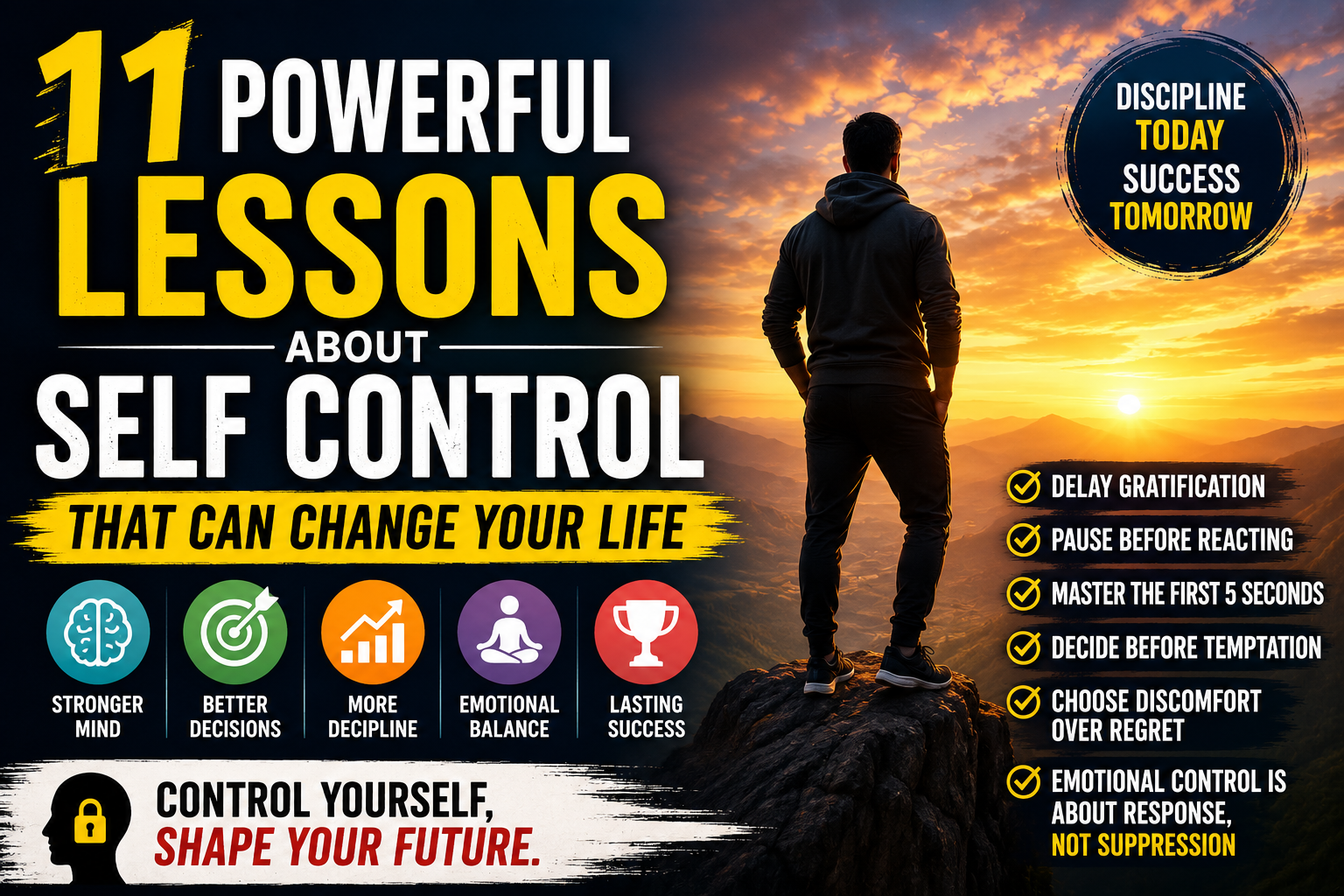
Have you ever promised yourself that you'd stop scrolling after five minutes, only to look up an hour later wondering where the time went?
Yeah, me too.
That's why self control fascinates me. It's one of those invisible skills that quietly shapes almost every part of our lives. Our health. Our finances. Our relationships. Even our happiness.
The truth is, self control isn't about becoming a robot who never feels tempted. It's not about forcing yourself to be perfect. Instead, it's about making choices that align with what you truly want, even when something easier, faster, or more tempting is sitting right in front of you.
The good news?
Nobody is born with unlimited self control. It's a skill. And like any skill, it can be strengthened over time.
Why Self Control Matters More Than Motivation
People often wait for motivation.
"I'll start exercising when I feel motivated."
"I'll save money when I feel inspired."
"I'll stop procrastinating tomorrow."
The problem is that motivation is unpredictable.
Some days it's there. Some days it disappears completely.
Self control, on the other hand, keeps working even when motivation takes a vacation.
Think of motivation as the weather.
Think of self-discipline and self control as the roof over your house.
One changes constantly. The other protects you regardless.
The Ability to Delay Gratification
One of the strongest signs of self control is the ability to delay gratification.
In simple terms, it means saying:
"I want this now... but I want something bigger later."
Examples include:
- Saving money instead of making impulse purchases
- Studying instead of binge-watching another episode
- Exercising instead of staying on the couch
- Eating healthier instead of grabbing junk food
The funny thing is that successful people aren't necessarily better at resisting temptation forever.
They're often just better at waiting.
That small ability to delay rewards can create huge results over time.
Why the First Five Seconds Matter
Here's something I've noticed.
Most bad decisions happen fast.
Really fast.
Sometimes before we're even fully aware of what's happening.
That's why self control grows when you master the first five seconds.
Those first few moments are where the battle usually happens.
Before:
- Clicking the unnecessary purchase
- Sending the angry text
- Eating the extra dessert
- Quitting a difficult task
If you can slow down those first five seconds, you create space between impulse and action.
And that space changes everything.
Try This Simple Question
Whenever temptation appears, ask yourself:
"Will I be happy about this decision tomorrow?"
That tiny pause can completely change the outcome.
Pause Before You React
This might be the most important lesson in the entire article.
Self control grows when you pause before reacting.
Someone criticizes you.
A coworker annoys you.
A family member says something frustrating.
Your first emotional response isn't always your best response.
I've learned that reacting immediately often creates problems that didn't need to exist.
Pausing doesn't mean weakness.
Pausing means you're taking control of the situation instead of letting the situation control you.
A few seconds of patience can prevent hours of regret.
Self Control Is Lost Before You Notice
Most people imagine losing self control as some dramatic moment.
But that's rarely how it happens.
Usually it starts with small decisions.
One skipped workout.
One unnecessary purchase.
One extra hour of procrastination.
One excuse.
Then another.
Then another.
The challenge is that these moments often feel insignificant.
Until they add up.
That's why protecting small decisions matters so much.
Because big outcomes are often built from tiny choices.
Decide Before Temptation Arrives
This is one of my favorite strategies.
Self control grows when you decide before temptation.
Don't wait until you're standing in front of temptation.
Make the decision earlier.
For example:
- Plan your meals before you're hungry.
- Set a budget before shopping.
- Schedule workouts before the week begins.
- Turn off notifications before starting work.
When the decision is already made, temptation loses much of its power.
You're no longer negotiating with yourself.
You've already chosen.
Limit Small Decisions
Have you ever felt mentally exhausted by lunchtime?
You haven't done anything physically demanding, yet your brain feels tired.
Part of that comes from decision fatigue.
Every small decision uses mental energy.
Questions like:
- What should I wear?
- What should I eat?
- What should I do first?
- Should I work now or later?
The more unnecessary decisions you make, the harder self control becomes.
That's why many productive people simplify routines.
A few helpful examples:
✅ Meal prep
✅ Daily to-do lists
✅ Consistent morning routines
✅ Scheduled work blocks
Reducing small decisions leaves more energy for important ones.
Choose Discomfort Over Regret
Here's a hard truth.
Growth usually feels uncomfortable.
Regret does too.
The difference is that one leads somewhere useful.
Self control is built when you choose discomfort over regret.
The discomfort of:
- Waking up early
- Exercising
- Saving money
- Learning new skills
- Having difficult conversations
These things may feel uncomfortable today.
But they often prevent much bigger discomfort later.
Whenever I face a difficult choice, I ask myself:
"Which discomfort would I rather have?"
That question has saved me from many poor decisions.
Emotional Control Is Not Emotional Suppression
This is where many people get confused.
They think emotional control means pretending not to feel emotions.
That's not true at all.
Emotional control is about mastering your response, not suppressing your feelings.
You can feel:
- Angry
- Sad
- Frustrated
- Disappointed
- Nervous
Those emotions are normal.
The goal isn't to eliminate them.
The goal is to choose how you respond.
Imagine emotions as passengers in a car.
They're allowed to ride along.
They just shouldn't be driving.
That's emotional intelligence in action.
Simple Ways to Build Self Control Every Day
Building self control doesn't require a complete life overhaul.
Small actions work surprisingly well.
1. Count to Five Before Acting
Create a brief pause between impulse and action.
2. Remove Temptation
Out of sight often means out of mind.
3. Use a Journal
Writing thoughts down can reduce impulsive decisions.
A simple notebook on your desk can become a surprisingly powerful tool.
4. Improve Sleep
Poor sleep weakens decision-making and emotional regulation.
5. Start Small
Don't try to change everything at once.
One small win repeated daily is more powerful than one huge effort.
6. Track Your Habits
Many people find habit trackers or simple planners helpful because they make progress visible without feeling overwhelming.