Old SEO vs New SEO — The Search Game Has Completely Changed
by Digyfindy
Tags:
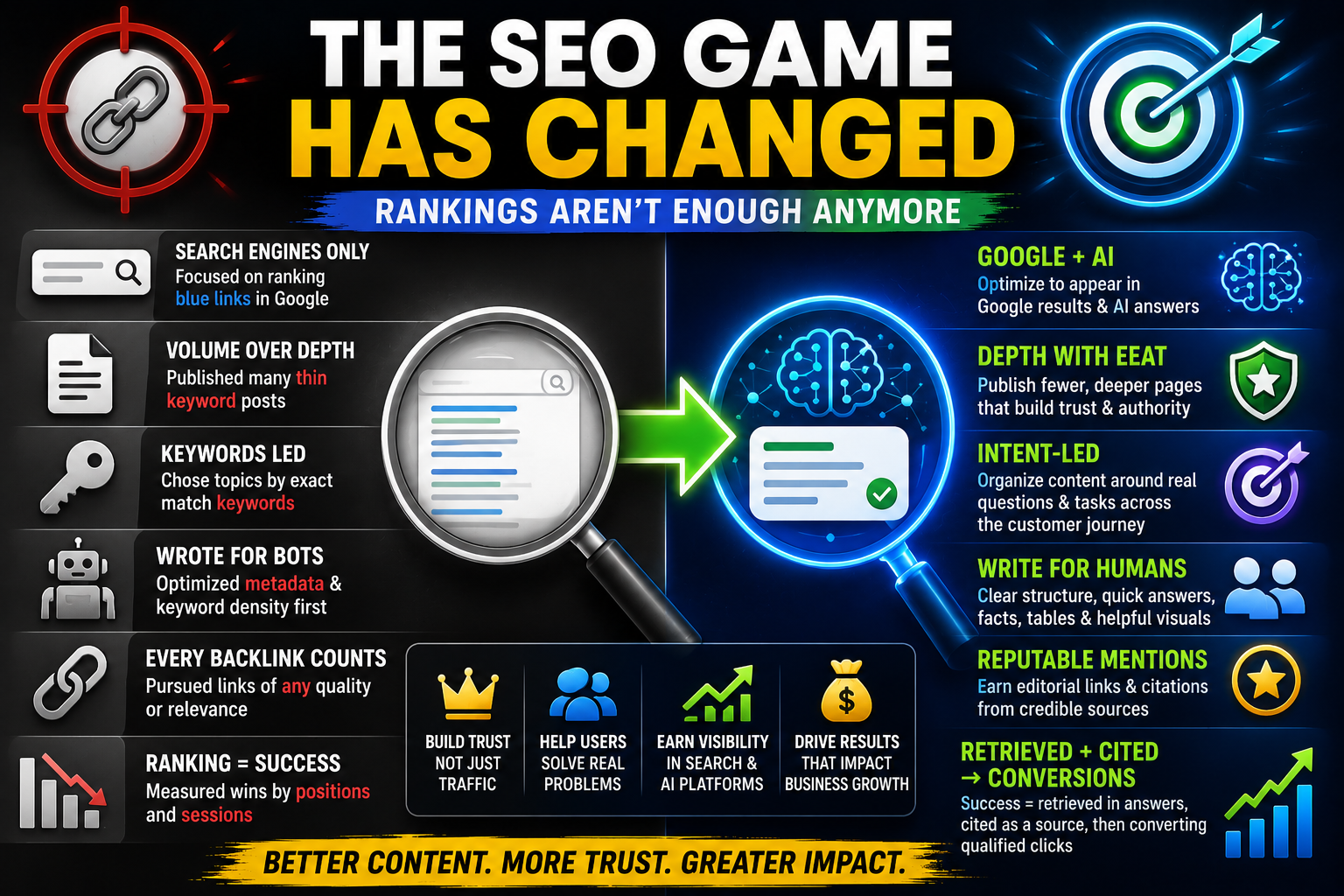
Old SEO vs New SEO — The Search Game Has Completely Changed
Introduction
If you’ve been doing SEO for a few years, you’ve probably noticed something strange lately:
The old tricks don’t work like they used to.
Back then, SEO felt simpler.
Find keywords.
Write articles.
Build backlinks.
Rank on Google.
Done.
But today? Search is completely different.
Now we have:
- AI-generated answers
- Google overviews
- Chatbots
- Voice search
- Topic authority
- User intent
- EEAT signals
- Entity-based search
Honestly, modern SEO feels less like “gaming an algorithm” and more like building actual trust online.
And that’s exactly why the conversation around old SEO vs new SEO matters so much in 2026.
What Old SEO Looked Like
Let’s be honest.
Old SEO wasn’t always terrible… but it was heavily focused on search engines instead of humans.
A lot of websites basically created content for algorithms first and readers second.
Google Was the Only Focus 🔍
Old SEO mainly revolved around one thing:
Ranking blue links on Google.
That was the entire goal.
Nobody cared much about:
- AI search answers
- Featured snippets
- ChatGPT citations
- Voice assistants
- Multi-platform discovery
If you ranked #1 on Google, life was good.
Simple times.
Volume Over Depth
One of the biggest old SEO habits was publishing massive amounts of thin content.
People created:
- Hundreds of short articles
- Keyword variations
- Near-duplicate posts
- Tiny informational pages
The strategy was basically:
“More pages = more traffic.”
And honestly… for a while, it worked.
But most of those articles weren’t actually helpful.
Keywords Led Everything
Old SEO was extremely keyword-driven.
People chose topics based mostly on:
- Exact-match keywords
- Search volume
- Low competition phrases
instead of thinking about:
- User problems
- Search intent
- Real questions
- Customer journeys
That’s why the internet became filled with awkward article titles like:
“Best Shoes Cheap Buy Online Men Running.”
Painful times 😂
Writing for Bots Instead of Humans
Old SEO content often sounded robotic because writers focused too heavily on:
- Keyword density
- Exact-match placement
- Metadata stuffing
- Repeating phrases unnaturally
Readability came second.
Humans noticed.
Eventually Google noticed too.
Every Backlink Counted
Backlinks became an obsession.
People chased:
- Directory links
- Spam blog comments
- Random guest posts
- Low-quality PBNs
- Irrelevant websites
because almost any backlink could help rankings.
Quality and relevance mattered far less than quantity.
Rankings Were the Main Goal 📈
Old SEO success was measured mostly by:
- Rankings
- Sessions
- Impressions
- Traffic volume
But here’s the weird part:
A site could rank well and still fail as a business.
Traffic without trust or conversions eventually becomes meaningless.
Why Old SEO Worked Back Then
To be fair, search engines were less advanced.
Google relied more heavily on:
- Keywords
- Link counts
- Basic page signals
AI understanding wasn’t nearly as sophisticated.
So websites could manipulate rankings more easily.
But search engines evolved fast.
Very fast.
The Rise of AI Search and Answer Engines 🤖
This changed everything.
Modern users increasingly get answers from:
- Google AI overviews
- ChatGPT
- Gemini
- Perplexity
- Voice assistants
People don’t always click blue links anymore.
Sometimes the answer appears instantly.
That means modern SEO is no longer just about rankings.
It’s about:
- Being retrieved
- Being trusted
- Being cited
- Being referenced by AI systems
Huge shift.
What New SEO Looks Like Today
Modern SEO focuses much more on usefulness, authority, and trust.
And honestly? That’s healthier for users.
Google + AI Optimization
New SEO means optimizing for:
- Google rankings
- AI-generated answers
- Featured snippets
- Voice search
- Semantic understanding
Search visibility now happens across multiple systems, not just traditional SERPs.
Depth + EEAT Matter More
Instead of publishing hundreds of weak articles, modern SEO rewards:
- Comprehensive guides
- Real expertise
- Experience
- Authority
- Trustworthiness
This is where Google’s EEAT framework matters.
Content now needs to feel:
- Helpful
- Accurate
- Credible
- Human
Thin content struggles much more today.
Intent-Led Content
Modern SEO starts with understanding:
“What does the user actually need?”
Not just:
“What keyword has volume?”
That’s a massive difference.
Today successful websites build:
- Topic clusters
- Journey-based content
- Problem-solving articles
- Helpful resources
instead of random disconnected posts.
Writing for Humans First ✍️
New SEO rewards readability.
Good content now uses:
- Clear structure
- Fast answers
- Helpful visuals
- Tables
- Scannable formatting
- Natural language
Ironically, writing naturally often performs better than over-optimized robotic content now.
Reputable Mentions Matter More
Modern SEO values:
- Editorial mentions
- Credible citations
- Brand authority
- Real reputation
A single strong mention from a respected publication can outperform dozens of spammy backlinks.
Quality finally matters more than raw quantity.
Rankings Alone No Longer Mean Success
This is one of the biggest mindset changes.
Today success means:
- Being cited in AI answers
- Building trust
- Converting visitors
- Growing authority
- Solving problems
A #1 ranking with zero conversions isn’t a real win anymore.
Businesses are finally realizing that.
How Businesses Should Adapt 🚀
If you want to succeed with modern SEO:
Focus on:
- Topical authority
- Helpful content
- Brand trust
- User experience
- EEAT
- Search intent
- Original insights
Stop obsessing over:
- Keyword stuffing
- Thin pages
- Spam backlinks
- Vanity traffic
Modern SEO rewards quality far more than shortcuts.