Meta Ads Campaign Structure Guide for Awareness, Leads & Sales
by Digyfindy
Tags:
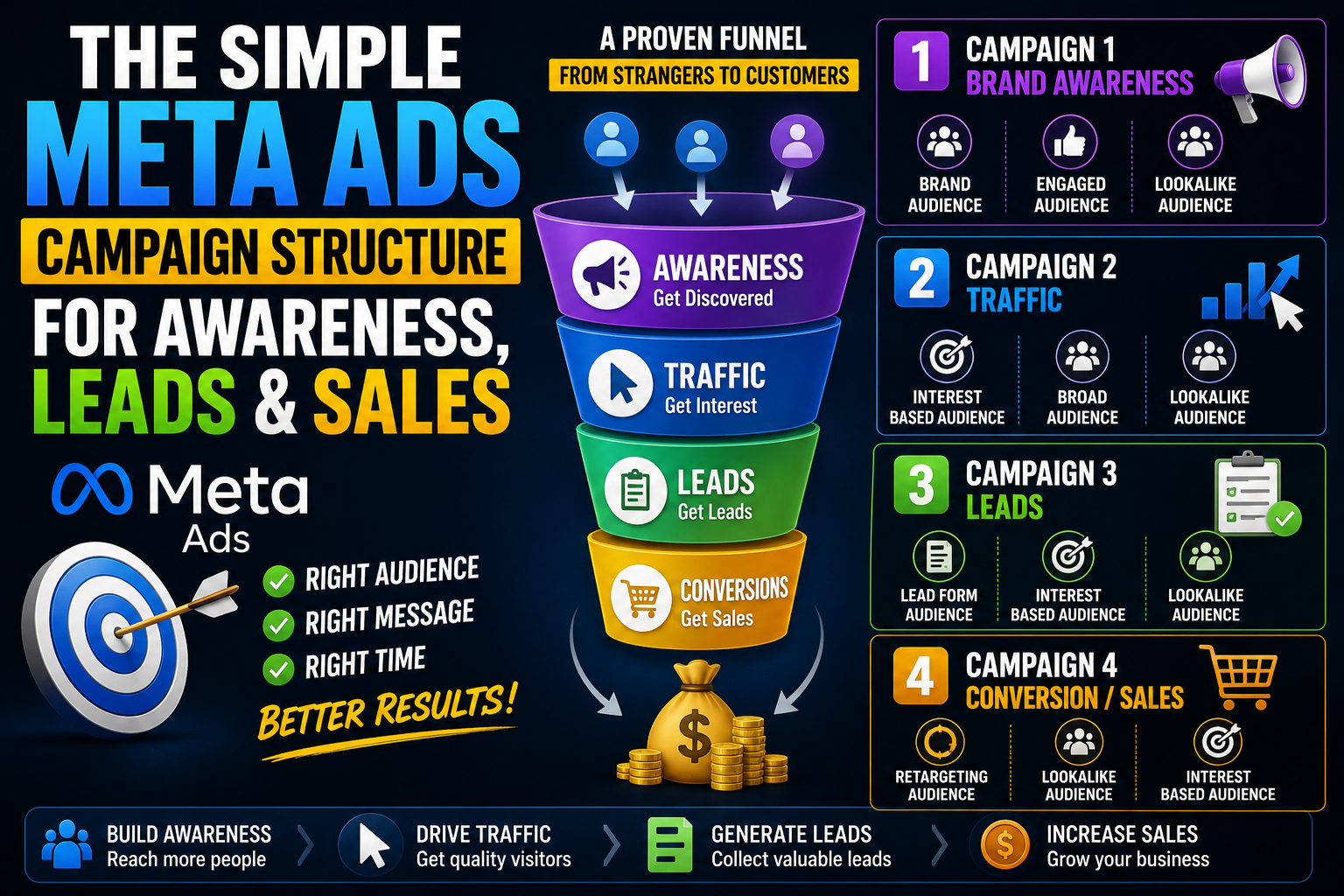
The Simple Meta Ads Campaign Structure I’d Use for Awareness, Leads, and Sales in 2026
Table of Contents
- Why Meta Ads Still Work
- The Biggest Mistake Beginners Make
- Understanding the Meta Ads Funnel
- Campaign 1 — Brand Awareness
- Campaign 2 — Traffic
- Campaign 3 — Leads
- Campaign 4 — Conversion / Sales
- Why Audience Structure Matters
- Budget Allocation Tips
- Common Meta Ads Mistakes
- Final Thoughts
- FAQs
The Simple Meta Ads Campaign Structure I’d Use for Awareness, Leads, and Sales in 2026
Introduction
Running Meta ads without a proper structure is honestly one of the fastest ways to waste money online.
A lot of beginners boost random posts, target everyone, and then wonder why they’re getting clicks but no sales.
I’ve seen it happen constantly.
The truth is, a good Meta ads campaign structure is less about “hacking the algorithm” and more about understanding customer behavior.
People usually don’t buy immediately.
First they notice your brand.
Then they get curious.
Then maybe they visit your page.
Then maybe they become leads.
Then eventually… they buy.
That’s why smart advertisers build campaigns in stages instead of trying to force instant conversions from cold audiences.
So let’s break down a simple, beginner-friendly Meta ads funnel using:
- Brand awareness
- Traffic campaigns
- Lead generation
- Conversion campaigns
without sounding like a complicated marketing course.
Why Meta Ads Still Work 📱
People love saying:
“Facebook ads are dead.”
And honestly? They’ve been saying that for years.
Yet businesses still spend billions on Meta ads because:
- Instagram attention is massive
- Facebook still has huge reach
- Meta targeting remains powerful
- Retargeting works incredibly well
The real problem usually isn’t the platform.
It’s the campaign structure.
The Biggest Mistake Beginners Make
Most beginners jump straight into sales ads targeting cold audiences.
That’s like proposing marriage before saying hello.
People need familiarity first.
Especially now when social media users see endless ads every day.
That’s why the best Meta ads campaign structure follows a funnel approach.
Understanding the Meta Ads Funnel
Here’s the simple flow:
Step 1:
People discover your brand
Step 2:
They engage with your content
Step 3:
They visit your website or landing page
Step 4:
Some become leads
Step 5:
A smaller percentage become customers
Simple idea.
Huge difference.
Campaign 1 — Brand Awareness
This is the “introduction phase.”
The goal here isn’t immediate sales.
It’s attention.
You want people to:
- Recognize your brand
- Remember your products
- Watch your videos
- Interact with your content
Think of this stage as warming up cold audiences.
Ad Sets for Brand Awareness
1. Brand Audience
This includes:
- Existing followers
- Page visitors
- Social media viewers
These people already know you a little.
They’re easier to engage.
2. Engaged Audience
Target people who:
- Liked posts
- Watched videos
- Saved content
- Messaged your page
These users already showed interest, which makes them valuable.
Honestly, engagement audiences are often underrated.
3. Lookalike Audience
Meta can create audiences similar to:
- Your followers
- Existing customers
- Website visitors
- Engaged users
This helps scale campaigns while keeping targeting relevant.
Lookalikes are one of Meta’s strongest tools when used properly.
Campaign 2 — Traffic
Now that people know your brand a little, the next step is getting them to visit your website or landing page.
This campaign focuses on:
- Website visits
- Product page traffic
- Blog traffic
- Landing page engagement
Ad Sets for Traffic Campaigns
1. Interest-Based Audience
This is where targeting matters.
Example interests:
- Fashion
- Fitness
- Gadgets
- Home decor
- Eco-friendly products
depending on your niche.
The key is relevance, not massive audience size.
2. Broad Audience
Sometimes Meta performs surprisingly well with broad targeting.
Especially if:
- Your creatives are strong
- Your pixel has enough data
- Your offer is clear
Meta’s AI has become much smarter recently.
3. Lookalike Audience
Again, lookalikes work extremely well in traffic campaigns because Meta already understands the type of people likely to engage.
This helps bring higher-quality visitors compared to completely random targeting.
Campaign 3 — Leads
This is where you start collecting actual customer information.
The goal becomes:
- Email signups
- WhatsApp inquiries
- Form submissions
- Free consultations
- Demo requests
Lead campaigns work especially well for:
- Services
- Coaching
- Real estate
- High-ticket products
- B2B businesses
Ad Sets for Lead Campaigns
1. Lead Form Audience
These are people who:
- Opened forms
- Started filling forms
- Submitted forms before
This audience is highly valuable because they already showed buying intent.
2. Interest-Based Audience
Still useful for finding fresh potential customers.
The trick is keeping the lead form simple.
Too many questions reduce conversions badly.
3. Lookalike Audience
Creating lookalikes from:
- Existing leads
- Past customers
- High-value clients
can dramatically improve lead quality.
Honestly, this is where Meta’s algorithm becomes incredibly powerful.
Campaign 4 — Conversion / Sales 💰
This is the final stage.
Now we target people most likely to buy.
At this point:
- They know your brand
- They visited your site
- They engaged with content
- Maybe they added products to cart
These are warm audiences.
And warm audiences convert much better.
Ad Sets for Conversion Campaigns
1. Retargeting
Probably the highest-converting audience.
Retarget:
- Website visitors
- Cart abandoners
- Instagram engagers
- Video viewers
- Past customers
Sometimes people just need a second reminder.
Or third.
Honestly, most people don’t buy the first time they see a product.
2. Lookalike Audience
Now you scale using customer-based lookalikes.
Meta tries finding users similar to actual buyers.
This is often where scaling starts happening.
3. Interest-Based Audience
Still useful, especially when paired with:
- Strong creatives
- Testimonials
- Social proof
- Limited-time offers
Good creative can outperform perfect targeting sometimes.
That part surprises many marketers.
Why Audience Structure Matters
Different audiences behave differently.
Cold audiences need:
- Education
- Attention
- Curiosity
Warm audiences need:
- Trust
- Proof
- Reminders
Hot audiences need:
- Simple checkout experiences
- Urgency
- Clear offers
That’s why separating campaigns properly matters so much.
Budget Allocation Tips 💡
A simple beginner-friendly structure could look like:
Awareness:
30%
Traffic:
25%
Leads:
20%
Conversion/Sales:
25%
Of course, this changes depending on:
- Business goals
- Industry
- Product pricing
- Funnel performance
But this is a decent starting point.
Common Meta Ads Mistakes
Here are mistakes I constantly see:
❌ Testing too many things at once
❌ Weak creatives
❌ No retargeting
❌ Complicated landing pages
❌ Ignoring mobile optimization
❌ Killing ads too early
❌ Running only sales campaigns
Patience matters more than people think.