How Many Teams Are in the FIFA World Cup 2026? The Complete Answer
by Digyfindy
Tags:
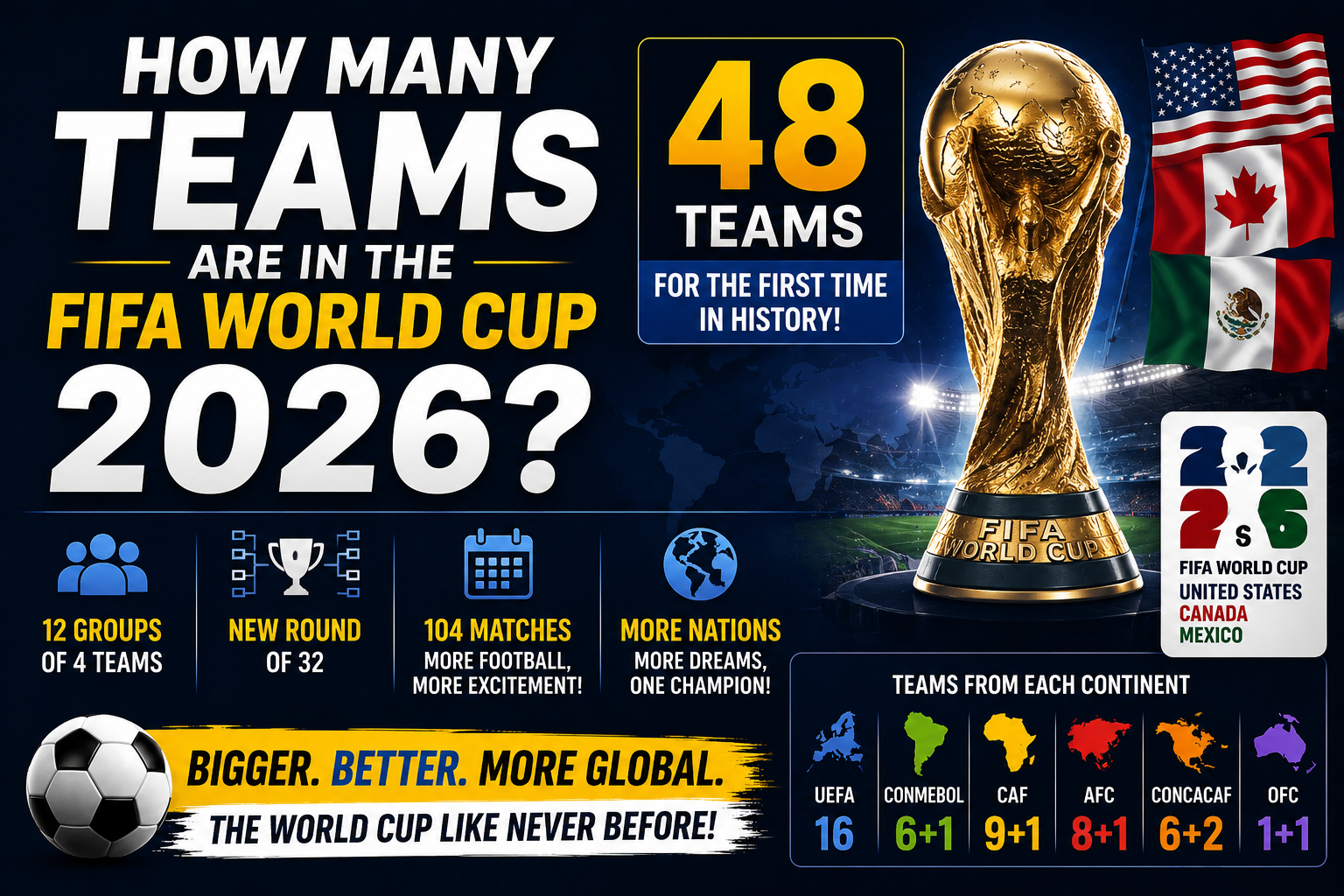
If you're wondering how many teams are in the FIFA World Cup 2026, the answer is simple:
The FIFA World Cup 2026 will feature 48 teams.
This is the biggest expansion in World Cup history. Previous tournaments, including the 2022 World Cup in Qatar, featured only 32 teams. The 2026 edition increases that number by 16 additional nations, giving more countries a chance to compete on football's biggest stage.
The FIFA World Cup 2026 will be hosted jointly by the United States, Canada, and Mexico, making it the first World Cup hosted by three countries.
But why did FIFA decide to expand the tournament? And how will the new format work?
Let's break it down.
The Big Change – From 32 to 48 Teams
For nearly three decades, the FIFA World Cup featured 32 teams.
That format was used from:
- France 1998
- South Korea/Japan 2002
- Germany 2006
- South Africa 2010
- Brazil 2014
- Russia 2018
- Qatar 2022
In 2026, FIFA is increasing the number to 48 teams, creating the largest World Cup ever held.
Quick Comparison
| Tournament | Teams |
|---|---|
| World Cup 2022 | 32 |
| World Cup 2026 | 48 |
This expansion means:
- More countries qualify
- More matches are played
- More fans get involved
- More regions are represented
For many football nations that regularly missed qualification, the change is a huge opportunity.
Why FIFA Expanded the World Cup in 2026
There are several reasons behind FIFA's decision.
1. More Global Representation
Football is played worldwide, but qualification spots were limited.
Many countries narrowly missed qualification despite having competitive teams.
Expanding to 48 teams allows more nations to participate.
2. Growing the Game
FIFA wants football to continue growing in regions such as:
- Africa
- Asia
- North America
- Oceania
Additional qualification spots encourage investment and development.
3. More Fan Engagement
When more countries qualify, more fans follow the tournament.
This creates:
- Higher TV audiences
- Increased ticket sales
- More global interest
4. Commercial Benefits
A larger tournament naturally creates additional revenue through:
- Broadcasting rights
- Sponsorships
- Advertising
- Tourism
While some critics question the expansion, FIFA believes the benefits outweigh the drawbacks.
How the 48 Teams Are Divided Into Groups
One of the biggest questions fans have is how the tournament format works.
The 2026 FIFA World Cup will feature:
12 Groups
Each group will contain:
- 4 teams
This means:
12 groups × 4 teams = 48 teams
After the group stage:
- The top two teams from each group advance
- The eight best third-place teams also advance
This creates a knockout stage featuring 32 teams.
The format allows more nations to remain competitive deep into the tournament.
How Many Teams From Each Continent Qualified?
The expansion significantly increases qualification spots across every confederation.
UEFA (Europe)
Europe receives the largest allocation.
16 spots
European teams traditionally perform strongly in World Cups, so UEFA gained several additional places under the new format.
Examples include:
- England
- France
- Germany
- Spain
- Italy
- Netherlands
and many more.
CONMEBOL (South America)
South America receives:
6 direct spots
plus
1 playoff spot
The continent features football powerhouses such as:
- Brazil
- Argentina
- Uruguay
- Colombia
Historically, South America has one of the highest qualification success rates.
CAF (Africa)
Africa receives:
9 direct spots
plus
1 playoff spot
This is a significant increase from previous tournaments.
Countries such as:
- Morocco
- Senegal
- Nigeria
- Egypt
- Ghana
benefit greatly from the expanded format.
AFC (Asia)
Asia receives:
8 direct spots
plus
1 playoff spot
This gives nations like:
- Japan
- South Korea
- Australia
- Saudi Arabia
more company on the world stage.
Asian football has improved dramatically over the past decade.
CONCACAF (North/Central America & Caribbean)
CONCACAF receives:
6 direct spots
plus
2 playoff spots
Additionally:
- USA
- Canada
- Mexico
automatically qualify as hosts.
This gives the region unprecedented representation.
OFC (Oceania)
Oceania receives:
1 direct qualification spot
plus
1 playoff spot
This is historic.
Previously, Oceania typically relied on intercontinental playoffs.
Now, the region is guaranteed at least one participant.
Countries like New Zealand benefit the most from this change.
How the New Round of 32 Works
One of the most exciting additions is the introduction of a full Round of 32.
After the group stage:
Qualified Teams
- 12 group winners
- 12 group runners-up
- 8 best third-place teams
Total:
32 teams
These teams enter a traditional knockout bracket.
Knockout Stages
- Round of 32
- Round of 16
- Quarter-finals
- Semi-finals
- Third-place playoff
- Final
This means teams must now survive an extra knockout round to win the World Cup.
As a result, the eventual champion will play more matches than previous winners.
What About the Number of Matches?
The expanded tournament increases the total number of matches.
World Cup 2022
64 matches
World Cup 2026
104 matches
That's a huge increase.
Fans will enjoy:
- More football
- More upsets
- More storylines
- More emerging nations
The tournament will also last longer than previous editions.
Could the Expansion Create More Upsets?
Possibly.
The larger format means more underdog nations will qualify.
Historically, some of the best World Cup stories come from unexpected teams.
Think of:
- Morocco's historic run in 2022
- Croatia's rise in 2018
- Senegal's breakthrough performances
More teams create more opportunities for surprises.
And that's often what makes international football so entertaining.