9 Key Differences Between Federal Law and State Law in America
by Digyfindy
Tags:
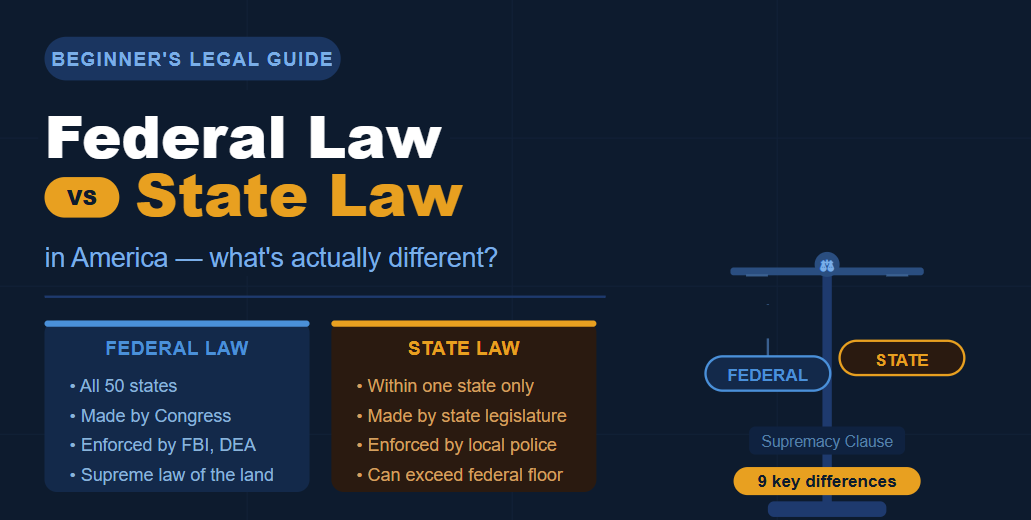
Table of Contents
- Wait — The US Has Two Different Legal Systems?
- What Is Federal Law, Exactly?
- What Is State Law, and Why Does It Exist?
- The Supremacy Clause: When Federal Law Wins
- When State Law Gets to Stay (The 10th Amendment)
- Real-Life Examples Where Federal and State Law Clash
- Federal Law vs State Law: A Side-by-Side Breakdown
- What Happens When You Break the Wrong One?
- Who Decides When They Conflict?
- FAQs
Wait — The US Has Two Different Legal Systems? {#intro}
Here's something that genuinely surprises a lot of people, including plenty of Americans who've been living under this system their whole lives: the United States doesn't run on just one set of laws. It runs on two — sometimes cooperating, sometimes colliding, and occasionally making people genuinely confused about what's actually legal.
Federal law applies to everyone in the country, from Maine to Hawaii. State law applies only within a specific state. And here's the twist — they don't always agree. In fact, on some really significant issues, they flat-out contradict each other.
Understanding the difference between federal law and state law in America isn't just useful if you're a lawyer. It's practically useful — for things like understanding your rights at work, knowing what you can and can't do when you travel between states, or just making sense of news stories where a state does something that seems to go against what the federal government says.
So let's actually break this down, plain and simple, with real examples you'll recognize.
1. What Is Federal Law, Exactly? {#what-is-federal-law}
Federal law is law that applies to the entire United States — all 50 states, every territory, every person living within US borders, and in many cases, US citizens abroad.
Federal laws are made by the US Congress (the Senate and the House of Representatives), signed into effect by the President, and enforced by federal agencies like the FBI, the DEA, the IRS, the ATF, and others. Federal courts — including the Supreme Court — handle disputes involving federal law.
The foundation of all federal law is the US Constitution, which was ratified in 1788. The Constitution is the highest law in the land. Everything else — every law Congress has ever passed — has to be consistent with it, or it can be struck down.
Examples of things governed primarily by federal law include:
- 💼 Immigration and citizenship
- 🛂 Border control and customs
- 💰 Federal taxes (collected by the IRS)
- 🔫 Federal firearms regulations
- 💊 Controlled substances (the DEA's drug schedules)
- 🌐 Interstate commerce and trade
- ⚖️ Bankruptcy
- 🪖 National defense and the military
- ✉️ The US Postal Service
These are areas where it makes sense to have one consistent national rule. You don't want 50 different immigration policies or 50 different armies.
2. What Is State Law, and Why Does It Exist? {#what-is-state-law}
State law is the set of laws that each individual US state creates and enforces within its own borders. Each state has its own legislature, its own governor, its own court system, and its own constitution.
This is intentional. When the country was founded, the original 13 states were essentially independent entities that agreed to form a union. They were not going to hand over all their power to a central government — they'd just fought a war to escape one of those. So the Constitution was carefully designed to give the federal government certain specific powers, while leaving everything else to the states.
Examples of things commonly governed by state law include:
- 🚗 Driving laws and licenses (speed limits, seatbelts, DUI rules)
- 🏠 Property and landlord-tenant law
- 💍 Marriage and divorce
- 🔪 Most criminal law (murder, theft, assault)
- 🏫 Public school systems
- 🩺 State medical licensing
- 🌿 Marijuana regulations (in many states)
- 💵 State minimum wage (when it exceeds the federal minimum)
- 🗳️ Voting rules and election administration
Why does this matter? Because state law can vary dramatically from one state to the next. Getting divorced in California follows different rules than getting divorced in Texas. Carrying a firearm legally looks different in Vermont than in New York. What's perfectly legal in Colorado can get you arrested the moment you cross into a different state.
America is, in a very real sense, 50 parallel legal systems operating inside one country — with a federal government sitting above them all.
3. The Supremacy Clause: When Federal Law Wins {#supremacy}
Okay, so what happens when federal law and state law say different things? Who wins?
In most cases: federal law wins. This principle comes from the Supremacy Clause, found in Article VI, Paragraph 2 of the US Constitution. In plain English, it says that the Constitution and federal laws are "the supreme Law of the Land" and that judges in every state are bound by them, regardless of what that state's own laws say.
The Supremacy Clause refers to the foundational principle that, in general, federal law takes precedence over any conflicting state law. Established under Article VI, Paragraph 2 of the US Constitution, the Supremacy Clause enables the federal government to enforce treaties, create a central bank, and enact legislation without interference from the states.
The mechanism through which this happens is called federal preemption. When a federal law conflicts with a state law, the federal law preempts (or overrides) the state one. Courts have established a few types of preemption:
- Express preemption — Congress explicitly writes into a law that states can't pass conflicting rules (like with medical devices or airplane safety)
- Field preemption — Congress regulates an area so thoroughly that states are essentially frozen out (like immigration law)
- Conflict preemption — The two laws directly contradict each other and you literally cannot obey both
Preemptive federal statutes now shape the regulatory environment for most major industries, including pharmaceutical drugs, securities, nuclear safety, medical devices, air transportation, banking, automobiles, and telecommunications.
So if California passes a law saying "you don't need to follow this federal banking regulation," California loses. Every time.
4. When State Law Gets to Stay: The 10th Amendment {#tenth-amendment}
Here's the flip side, and this is where it gets genuinely interesting.
The federal government doesn't have unlimited power to override states. The 10th Amendment to the Constitution says that all powers not specifically granted to the federal government by the Constitution are "reserved to the States respectively, or to the people."
That's a big deal. It means the federal government can't just walk into every area of life and start making rules. There has to be a constitutional basis for it. And there are entire domains where federal law traditionally doesn't go — family law, most criminal law, education — because those have long been considered state territory.
There's also something called the anti-commandeering doctrine, which says the federal government can't force state governments to enforce federal law. The Tenth Amendment's anti-commandeering rule prohibits Congress from forcing states to mirror or enforce federal policies. While the federal government is free to enforce its own marijuana laws, requiring state agents to enforce federal laws is unconstitutional commandeering of a state's resources.
So the federal government can say "this is illegal under federal law." But it can't make state police arrest people for it or force state courts to prosecute it. That's a distinction with very real consequences — as you'll see in the marijuana example below.
5. Real-Life Examples Where Federal and State Law Clash {#examples}
This is the part that makes the abstract stuff click. Here are some of the biggest, most visible real-world clashes between federal law and state law in America right now.
🌿 Marijuana: Legal in Your State, Still a Federal Crime
This one trips people up constantly, and it's genuinely one of the most dramatic examples of the federal vs. state divide.
Marijuana is a Schedule I controlled substance under the federal Controlled Substances Act (CSA), and thus is strictly regulated by federal authorities. In contrast, over the last several decades, most states and territories have deviated from a comprehensive prohibition of marijuana and have laws and policies allowing for some cultivation, sale, distribution, and possession of marijuana.
As of early 2026, 24 states, Washington DC, Guam, and the Northern Mariana Islands have enacted laws allowing recreational marijuana use. But under federal law, it remains controlled — and the consequences of that gap are very real.
Even a weekend hike can be tricky: possessing marijuana in a National Park is a federal offense, even if that park is right in the middle of a "legal" state. Bringing marijuana through an airport or across a border is a specialized federal crime.
And it gets even more complicated. Federal law prohibits gun ownership and possession by any person who is an "unlawful user of or addicted to any controlled substance," with no exception for users of state-legal medical marijuana. So in states where marijuana is perfectly legal under state law, using it can still technically cost you your federal right to own a firearm.
💵 Minimum Wage: The Floor Is Federal, But States Can Go Higher
The federal minimum wage has been $7.25 per hour since 2009 — and it hasn't changed since. That's the national floor set by federal law. No employer in the country can legally pay less than that.
But states can set higher minimums. And many do. Twenty-one states changed or committed to changing their minimum wage rate on January 1st, 2025. New York City, Long Island, and Westchester County set their rate at $16.50 per hour; the rest of New York State at $15.50. Meanwhile, 20 states still use the federal minimum wage rate of $7.25.
So a worker doing the same job in Seattle might earn double what a worker in Mississippi earns — because state law can exceed the federal baseline, but not fall below it.
🔫 Gun Laws: Federal Baseline, State Variations
Federal law establishes a baseline national standard regarding the criteria that make people ineligible to acquire and possess firearms. The federal Gun Control Act of 1968 generally prohibits the sale to, and possession of firearms by, a person who has been convicted of a federal crime punishable by imprisonment for more than one year.
That's the floor. States can build on it. California has among the strictest gun laws in the country — assault weapon restrictions, waiting periods, red flag laws. Vermont allows permitless carry with almost no restrictions. Both are operating within federal law — they're just exercising the state authority to add (or not add) rules on top.
🏳️🌈 Marriage and Civil Rights: When Federal Settled What States Divided
For years, same-sex marriage was legal in some states and illegal in others. This created genuine legal chaos — a couple legally married in Massachusetts had no recognized status when they moved to Alabama. It took a Supreme Court ruling (Obergefell v. Hodges, 2015) to settle the question at the federal law level, making same-sex marriage legal nationwide, overriding the state laws that had prohibited it.
This is an example of federal constitutional law expanding rights beyond what some states were willing to grant — the system working in the opposite direction.
6. Federal Law vs State Law: A Side-by-Side Breakdown {#comparison}
| Federal Law | State Law | |
|---|---|---|
| Who makes it | US Congress | State legislature |
| Who enforces it | FBI, DEA, IRS, ATF, etc. | State/local police, state agencies |
| Where it applies | All 50 states + territories | Only within that state |
| Highest authority | US Constitution | State constitution (must comply with federal) |
| Court system | Federal courts, Supreme Court | State courts |
| Examples | Immigration, drug schedules, federal taxes | Driving rules, marriage, most crimes |
| When they conflict | Federal law wins (usually) | State law may stand if no federal intent to preempt |
7. What Happens When You Break the Wrong One? {#consequences}
This is a really practical question. Can you be charged under both federal law and state law for the same act?
The short answer is: yes. This is called dual sovereignty, and it's been upheld by the Supreme Court repeatedly. The federal government and each state are considered separate sovereigns — so if your action breaks both a federal law and a state law, you can actually be prosecuted by both systems.
This happens most commonly in:
- Drug cases — Violating the federal Controlled Substances Act and a state drug law simultaneously
- Civil rights violations — Someone acquitted at the state level can still face federal civil rights charges
- Fraud and financial crimes — Where both state fraud statutes and federal wire fraud or bank fraud laws apply
It sounds harsh, and honestly, it can be. The key thing to understand is that federal law tends to carry heavier penalties, federal prisons are different from state prisons, and federal prosecutors have different priorities than local DAs.
And as mentioned earlier — the federal government can enforce its own laws. It just can't force states to do it for them. So the DEA can still arrest someone for marijuana in a state where it's legal under state law. They generally don't pursue small personal-use cases, but they legally can.
8. Who Decides When They Conflict? {#who-decides}
Courts. Ultimately, the judicial system — and at the top, the US Supreme Court — decides when a state law crosses into federal territory or when a federal law has overstepped its constitutional authority.
In modern times, the Supreme Court has recognized various ways in which federal statutes can displace or "preempt" state law. Some federal statutes include express "preemption clauses" forbidding states to enact or enforce certain kinds of laws. A few other federal statutes have been interpreted as implicitly stripping states of lawmaking power throughout a particular field. Every year, courts decide an enormous number of cases that involve whether a particular federal statute should be understood to preempt a particular aspect of state law.
This is why constitutional lawyers exist. The tension between federal law and state law isn't a bug in the American system — it's kind of a feature. The Founders didn't want all power in one place. They wanted a system with built-in friction, checks, and multiple levels of government competing to represent different interests.
Sometimes that means the law is genuinely unclear and people get caught in the middle. But it also means that states can act as "laboratories of democracy" — trying out new policies (like marijuana legalization or stricter environmental rules) that the federal government isn't ready to adopt yet.
FAQs: Federal Law vs State Law in America {#faqs}
❓ Does federal law always override state law in America?
Not automatically. When a federal law conflicts with state law, the federal law prevails. While states may make their own laws, they must meet or exceed the federal standard. But federal law should not preempt state law "unless that was the clear and manifest purpose of Congress." In areas where Congress hasn't clearly regulated, state law can stand — and states can always provide more protection than federal law requires, just not less.
❓ What does "federal preemption" mean in plain English?
It means the federal government has stepped in and claimed authority over an area, which means state laws in that area get pushed aside. Think of it like a highway: the federal government owns the highway, and states can add rest stops and speed limits on their local roads, but they can't put up a toll booth in the middle of I-95 that contradicts federal highway rules.
❓ Can I be arrested by both federal and state authorities for the same thing?
Yes, legally you can. This is the dual sovereignty doctrine. The Supreme Court reaffirmed this in Gamble v. United States (2019). The Double Jeopardy Clause (which protects you from being tried twice for the same crime) doesn't apply when the two charges come from two separate sovereigns — a state and the federal government. In practice, federal and state prosecutors usually coordinate, but they don't have to.
❓ Why do some states seem to ignore federal law — like with marijuana?
They're not exactly ignoring it — they're declining to enforce it and choosing not to criminalize it under their laws. Thanks to the anti-commandeering doctrine, the federal government can't force states to arrest people under federal law. The Tenth Amendment's anti-commandeering rule prohibits Congress from forcing states to mirror or enforce federal policies. So states like Colorado or California aren't violating the Constitution by legalizing marijuana — they're just not participating in the federal enforcement of it. The federal government is still free to enforce its own laws there.