20 Brain-Boosting Activities for Babies (0–12 Months) to Support Early Development
by Digyfindy
Tags:
20 Brain-Boosting Activities for Babies (0–12 Months) to Support Early Development
Have you ever noticed how your baby can spend several minutes staring at a ceiling fan, watching your face, or trying to grab a toy? It's amazing how curious little ones are, even when they're only a few months old!
During the first year, babies learn something new through almost everything they experience. A familiar voice, a gentle touch, a colourful toy, or a simple game of peek-a-boo can all become opportunities to explore the world.
That's why brain-boosting activities for babies don't need to involve expensive toys, complicated games, or special learning equipment. Some of the best activities are the simplest ones you can do at home.
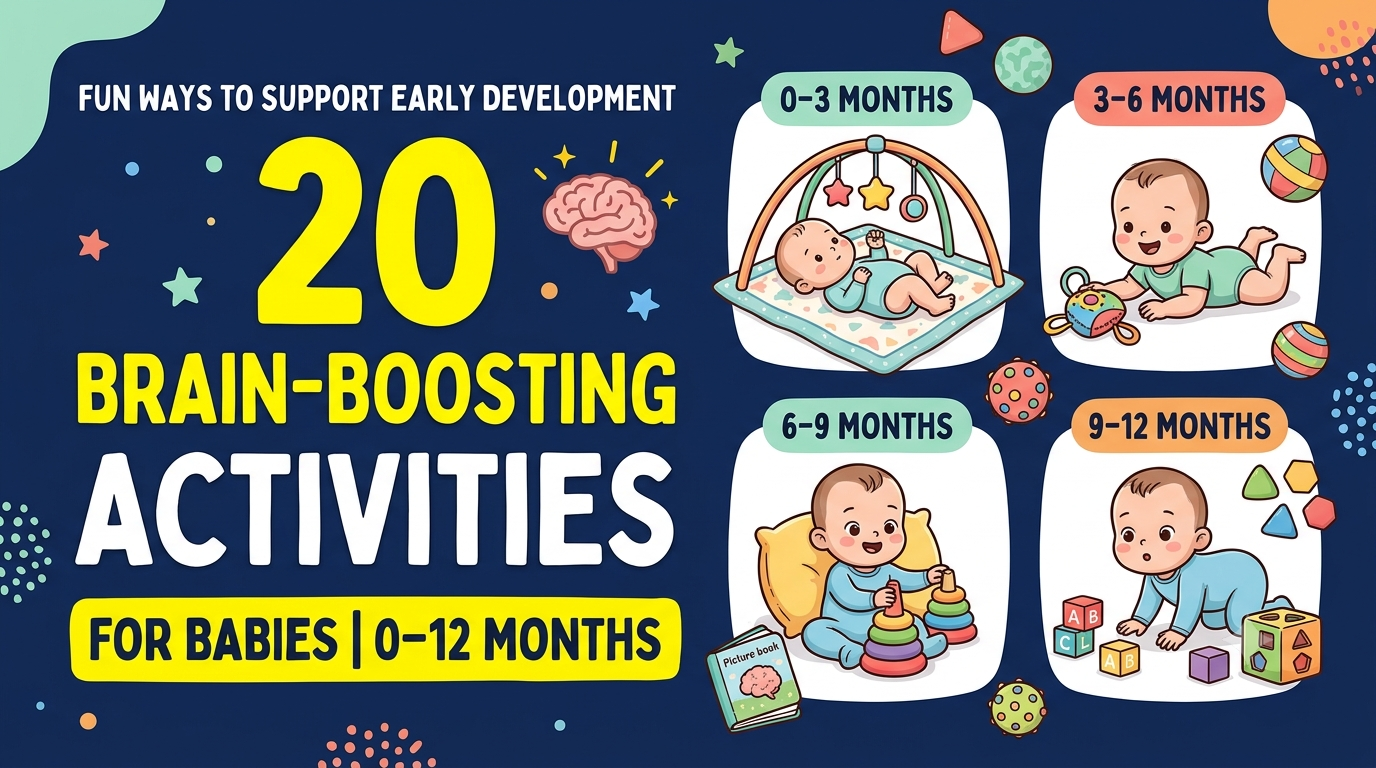
In this guide, I'll share 20 brain-boosting activities for babies aged 0–12 months, divided into four age groups. You'll find easy ideas for sensory play, communication, movement, curiosity, and bonding.
Whether you're a first-time parent or already have a little experience, these activities can help make everyday playtime more meaningful.
One important thing before we begin: Every baby develops at their own pace. These age groups are general guides, not strict milestones. Follow your baby's interest, take breaks when needed, and enjoy the little moments together.
Table of Contents
Why Are Brain-Boosting Activities Important for Babies?
The first year of life is full of learning and discovery.
Your baby's brain is developing rapidly, and everyday experiences help build connections that support communication, movement, memory, and understanding.
But here's something many new parents don't realise: You don't have to teach your baby like a student.
Babies learn through simple interactions, including:
-
Hearing your voice.
-
Watching your facial expressions.
-
Feeling different safe textures.
-
Reaching for toys.
-
Listening to music.
-
Exploring objects.
-
Playing simple games with you.
These experiences encourage babies to use their senses, practise new movements, and interact with the people around them.
For example, when you smile at your baby and they smile back, you're sharing an early social experience. When they reach for a rattle, they're practising coordination and learning about movement.
It's all learning, even when it looks like ordinary play!
1. Brain-Boosting Activities for 0–3 Months
<text> <escape></escape> </text>
<text> <escape> </escape> </text>
The first three months are mostly about getting comfortable with the world outside the womb.
Your baby is learning to recognise familiar voices, look at faces, respond to sounds, and gradually gain control over their movements.
Keep activities short and gentle. Your face, voice, and touch are often more interesting than any toy.
1. Talk to Your Baby Face-to-Face
<text> </text>
One of the easiest ways to encourage early communication is simply talking to your baby.
Hold your baby comfortably and let them look at your face while you speak.
You can:
-
Tell them what you're doing.
-
Describe things around the room.
-
Smile and make gentle facial expressions.
-
Pause to give them time to respond.
Your baby may not understand your words, but hearing your voice helps them become familiar with the sounds and rhythms of language.
2. Sing and Hum Together
You don't need a perfect singing voice. Your baby is probably your most forgiving audience!
Sing lullabies, nursery rhymes, or simple songs.
Try repeating the same songs regularly. Babies enjoy familiar sounds, and your voice can be comforting.
You can also gently change your tone or rhythm to make songs more interesting.
3. Show High-Contrast Pictures
Young babies may enjoy looking at simple black-and-white patterns.
Try showing:
-
Black-and-white picture cards.
-
Simple geometric shapes.
-
High-contrast board books.
Hold the pictures at a comfortable viewing distance and give your baby time to look.
You don't need to show lots of pictures at once. A few simple patterns are enough.
4. Give Gentle Touch and Massage
Gentle touch can be a lovely way to bond with your newborn.
When your baby is calm and comfortable, gently stroke their arms, legs, hands, or feet.
You can also try a gentle baby massage if your baby enjoys it.
Keep your movements soft and watch your baby's reactions. Stop if they seem uncomfortable, and avoid massaging immediately after feeding.
5. Try Supervised Tummy Time
Tummy time gives your baby an opportunity to practise lifting and turning their head while strengthening muscles used for movement.
Here's how to make it enjoyable:
-
Choose a time when your baby is awake and alert.
-
Place them on their tummy on a firm, flat surface.
-
Stay close and supervise them throughout.
-
Get down to their level and talk or smile.
-
Start with a few minutes at a time and gradually build up as they become comfortable.
You can also try tummy time on your chest while you're fully awake and alert.
Important: Always place your baby on their back for sleep. Tummy time is only for awake, supervised play.
The goal at this age: Early bonding, listening, visual attention, sensory experiences, and physical development.
2. Baby Brain Development Activities for 3–6 Months
Your baby is becoming more active!
You may notice more smiles, sounds, reaching, grasping, and interest in objects around them.
This is a lovely stage to introduce simple sensory and movement activities.
6. Try Mirror Play
Babies often find faces fascinating, especially their own reflection.
Place a baby-safe, unbreakable mirror in front of your baby during supervised play.
Let them look at the reflection while you talk.
You can smile, wave, or make gentle expressions.
They may not understand that they're looking at themselves yet, but watching faces can make playtime interesting.
7. Encourage Reaching and Grasping
Place a lightweight, age-appropriate toy within your baby's reach.
Encourage them to stretch their arms and try to grab it.
You can use:
-
Soft fabric toys.
-
Lightweight rattles.
-
Baby-safe textured toys.
Move the toy gently from one side to another, allowing your baby to follow it with their eyes and hands.
Never use toys with small detachable parts or long strings.
8. Explore Different Sounds With Rattles
Babies are curious about sounds.
Use a lightweight baby-safe rattle to make gentle sounds from different directions.
Pause and see whether your baby turns their head or looks towards the sound.
You can also introduce other gentle sounds, such as soft music or the sound of your voice.
Avoid loud or sudden noises close to your baby's ears.
9. Play Clapping and Action Songs
Simple songs with repeated actions can make playtime more interactive.
Try songs that involve gentle hand movements, clapping, or finger actions.
You can move your hands slowly while singing and let your baby watch.
As your baby grows, they may start responding with smiles, movements, or sounds.
10. Respond to Your Baby's Babbling
Have you noticed your baby making little sounds like "ah," "oo," or "ba"?
Those sounds are worth responding to!
When your baby makes a sound:
-
Smile.
-
Repeat the sound.
-
Talk back.
-
Pause and let them make another sound.
Think of it as your first little conversation.
This simple back-and-forth interaction encourages early communication and social connection.
The goal at this age: Sensory exploration, hand-eye coordination, sound awareness, and early communication.
3. Brain-Boosting Activities for Babies Aged 6–9 Months
Now comes a particularly fun stage.
Your baby may become more interested in exploring objects, playing games, and interacting with people.
They may also start sitting with support or independently, reaching for toys, and moving objects between their hands.
Here are some activities to try.
11. Play Peek-a-Boo
This classic game never gets old!
Cover your face with your hands, then uncover it while saying, "Peek-a-boo!"
You can also hide behind a cloth and reveal your face.
Your baby may smile, laugh, or get excited when you appear again.
It's a simple way to encourage social interaction and introduce the idea that something can still exist even when it's out of sight.
12. Hide and Find Toys
Choose a familiar, safe toy and partially hide it under a lightweight cloth.
Let your baby watch as you cover the toy.
Then encourage them to find it.
You can say, "Where's your ball?"
Start by hiding only part of the toy so the activity stays easy and enjoyable.
Always use a lightweight cloth, supervise closely, and never cover your baby's face.
13. Explore Picture Books Together
Picture books become even more interesting as babies start noticing familiar objects.
Choose books with:
-
Large pictures.
-
Simple illustrations.
-
Everyday objects.
-
Animals and familiar faces.
Point to the pictures and name them.
For example, "Look, that's a cat!" or "Can you see the red ball?"
Let your baby touch and explore sturdy books under supervision.
14. Explore Safe Household Objects
Babies love discovering ordinary things.
You don't always need a new toy. Sometimes a familiar household object can be interesting when introduced safely.
Try offering:
-
A large wooden spoon without sharp edges.
-
A soft washcloth.
-
A lightweight plastic cup.
-
A large, baby-safe fabric ball.
Let your baby touch and explore the objects while you supervise.
Avoid anything with sharp edges, detachable parts, small pieces, batteries, magnets, or choking hazards.
15. Encourage Passing Toys Between Hands
Give your baby a lightweight toy that is easy to hold.
Encourage them to explore it with both hands.
You can gently offer the toy from one side and let them reach for it.
Many babies begin practising transferring objects between hands during this stage.
This activity gives them opportunities to practise coordination and explore how their hands work.
The goal at this age: Curiosity, object exploration, coordination, social interaction, and early problem-solving.
4. Learning Activities for Babies Aged 9–12 Months
Your little explorer is getting closer to their first birthday!
At this stage, many babies become more interested in familiar words, simple gestures, objects, and movement.
They may also enjoy repeating activities they already know.
Here are five easy activities to try.
16. Name Everyday Objects
Use everyday routines to introduce familiar words.
Point to objects and say their names clearly.
For example:
-
Ball.
-
Cup.
-
Spoon.
-
Shoe.
-
Book.
-
Teddy.
You can also describe what you're doing.
"Here is your cup."
"Let's put on your shoes."
Repeating familiar words helps your baby connect sounds with objects.
17. Practise Simple Gestures
Babies often enjoy copying simple actions.
Try practising:
-
Waving bye-bye.
-
Clapping hands.
-
Blowing kisses.
-
Raising hands.
-
Playing simple hand-action games.
Show the movement slowly and repeat it.
Don't worry if your baby doesn't copy you immediately. They may need time to watch and practise.
18. Try Simple Put-In and Take-Out Games
This is an easy activity that encourages exploration.
Use a large, sturdy container and a few large baby-safe toys.
Show your baby how to put a toy inside and take it out again.
You can say:
-
"Put it in!"
-
"Take it out!"
-
"Where did it go?"
Let your baby try at their own pace.
Make sure every object is too large to be a choking hazard and supervise throughout.
19. Read Together Every Day
Reading doesn't need to be a long activity.
Even a few minutes with a picture book can become a special part of your daily routine.
Point to familiar pictures, name objects, and make animal sounds.
Your baby may try to turn pages, touch pictures, or make little sounds.
Let them participate rather than expecting them to sit quietly through the entire book!
20. Encourage Crawling, Standing, and Safe Movement
As your baby becomes more mobile, give them safe opportunities to explore movement.
You can:
-
Place a favourite toy nearby to encourage reaching.
-
Offer space for crawling on a clear floor.
-
Encourage supported standing when your baby is ready.
-
Let them move between safe, stable play areas.
Always supervise closely and make sure furniture is secure.
Avoid baby walkers with wheels, which can increase the risk of injuries.
Never force your baby into a movement they're not ready for.
The goal at this age: Communication, gestures, coordination, problem-solving, and safe physical exploration.
Everyday Tips to Support Your Baby's Brain Development
You don't need to schedule every activity or follow a strict learning timetable.
In fact, some of the most meaningful learning happens naturally throughout the day.
Here are a few simple habits worth practising.
Talk During Everyday Activities
Talk to your baby while changing clothes, preparing food, bathing, or going for a walk.
Describe what you're doing and name familiar objects.
These little conversations provide regular opportunities to hear language.
Follow Your Baby's Interest
If your baby is enjoying a particular toy or activity, let them explore it for a while.
You don't have to move on to another activity just because it's on your list.
Sometimes repeating the same game is exactly what your baby enjoys.
Keep Activities Short
Babies can become tired or overstimulated quickly.
Watch for signs such as:
-
Looking away.
-
Becoming fussy.
-
Yawning.
-
Turning their head away.
-
Crying.
When your baby seems tired, take a break.
Choose Age-Appropriate Toys
A few simple toys are enough.
Useful options include:
-
Soft sensory toys.
-
High-contrast books.
-
Baby-safe mirrors.
-
Lightweight rattles.
-
Textured fabric books.
-
Large stacking cups.
Always check age recommendations and inspect toys for loose parts, damage, or choking hazards.
Give Plenty of Love and Attention
Your baby doesn't need you to entertain them every minute.
Talking, smiling, cuddling, responding to their sounds, and spending time together all matter.
The best brain booster isn't an expensive toy. It's the loving interaction your baby experiences every day.
Frequently Asked Questions About Brain-Boosting Activities for Babies
1. What Are the Best Brain-Boosting Activities for Babies?
Simple activities such as talking, singing, reading picture books, tummy time, peek-a-boo, and sensory play are wonderful ways to encourage early learning. Choose activities that suit your baby's age and interests.
2. How Can I Improve My Baby's Brain Development at Home?
You can support your baby's development through everyday interactions. Talk to them, respond to their sounds, read together, offer safe toys to explore, encourage movement, and provide plenty of loving attention.
3. How Many Activities Should I Do With My Baby Each Day?
There is no fixed number. You can introduce a few short activities throughout the day and include learning naturally during feeding, playtime, and daily routines. Follow your baby's mood and allow plenty of time for rest.
4. Do Babies Need Educational Toys for Brain Development?
No. Educational toys can be enjoyable, but they're not essential. Everyday objects that are safe for your baby's age, picture books, songs, and interactions with caregivers provide plenty of learning opportunities.
Final Thoughts: The Best Brain Booster Is You!
When it comes to brain-boosting activities for babies, it's easy to think you need special toys, expensive products, or a perfectly planned routine.
But the truth is much simpler.
Your time, your words, your touch, and your love make a meaningful difference in your baby's everyday experiences.
Talk to them. Sing together. Read a little book. Play peek-a-boo. Let them explore safe objects and discover the world around them.
Some days, your baby may enjoy every activity. Other days, they may just want a cuddle and a nap. That's completely normal!
Remember, every baby learns at their own pace. Follow their interests, keep playtime positive, and enjoy watching those little changes happen.
Play. Explore. Connect. Grow. ❤️
If you found these baby development activities helpful, share this guide with another parent. And don't forget to explore more baby care and parenting ideas for simple ways to make everyday moments meaningful.